
CLASS 99
The blog for design law, in Europe and worldwide. This weblog is written by a team of design experts and fans. To contribute, or join us, or for any other reason, email class99@marques.org.
Want to receive Class 99 by email?
Click here subscribe for free.
Click here subscribe for free.
Who we all are...
MONDAY, 10 OCTOBER 2011
Inherency – a reduction of protection for IVARS?
Tags: appeal, design freedom, general court, individual character, invalidation, not visible, RCD,
Perm-A-Link: https://www.marques.org/blogs/class99?XID=BHA291
Inherency – a reduction of protection for IVARS?
Clearly the right decision – but correctly based? Or have we developed a new doctrine - that a picture discloses more than it shows?
The General Court last week rejected an appeal (Case T-246/10, Industrias Francisco Ivars v OHIM - Motive intervening (Reducers)) concerning a speed reducing gearbox for a motor. The judgment is in French, so we bring you edited highlights (with thanks to Katie Cameron for help understanding it all).
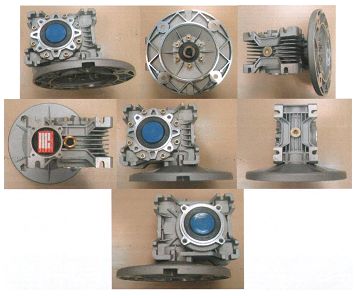
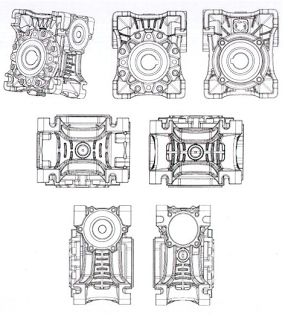
Motors tend to run fast but weak, so speed reducing gearboxes (here called reducers) are commonly coupled on. Sometimes they are sold together with the motor, sometimes separately. The design in this case (shown below), RCD 000625702-0001, was of a separate gearbox with a mounting flange (for accepting an axle) attached to it.
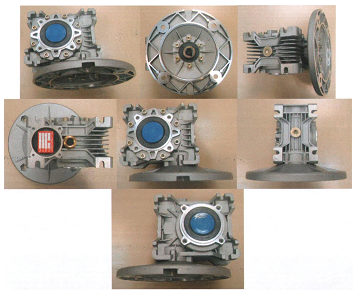
It bore more than a passing resemblance to a prior design, RCD 000073952-0001, to the extent that the proprietor of the prior design promptly brought an invalidation action at OHIM, within six months of grant.
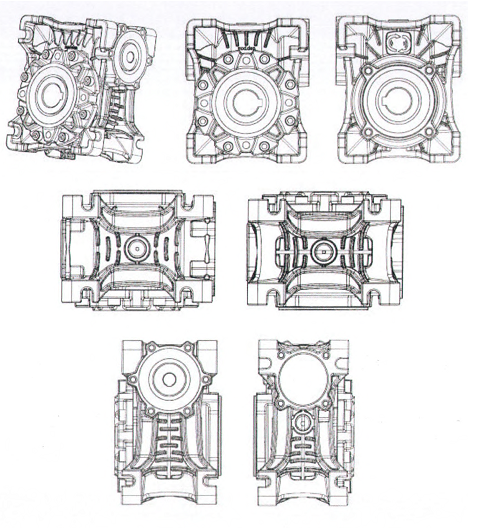
Comparing the two, the major difference is obviously the presence of the flange in the design in suit, and the corresponding invisibility of the few features hidden by it. It seems to have been common ground that a flange would have been present in normal use of the prior art, and that the flange of the design in suit was of a pretty commonplace appearance.
The Invalidation Division held (Decision ICD 000003960, 23/07/08) that this addition conferred novelty and individual character. They were reversed on appeal (R 1337/2008-3, 16/03/2010), the Board holding that the later design “inevitably produces the same overall impression as the prior design on the informed user because it reproduces all the characteristic features of the prior design and does not do anything else than adding another element which is part of the normal use for this type of products.” Although both OHIM decisions were in Spanish, there was an English summary in Alicante News.
One can see that the Board achieved a satisfactory outcome, but it is rather hard to see the basis by which they did so – how can gearbox+flange=gearbox? Had it been shown that (as is likely) the flange was hidden in normal use of the product, the outcome would have been justified by CDR Art 4(2), but this does not seem to have been proven – and perhaps the proprietor of the earlier design was hesitant to invoke a ground that would result in his earlier RCD being itself invalid on the same basis.
At first blush, then the OHIM decision appears to mosaic together two disclosures (the prior design and a notional flange) for an individual character attack – something which OHIM and the national courts have hitherto been against. But perhaps there is more to it than that. Although they rejected on lack of individual character rather than lack of novelty, it may be that the Board’s decision was essentially one of “inherent disclosure”, a patent law concept described in, for example, the EPO Guidelines for Examination at C-IV, 9.2.
That approach is based on the suggestion that a given disclosure teaches more to the skilled reader than is expressly mentioned; for example, mention of a bicycle implies the presence of two wheels. In this case, the informed user, seeing the motor with a port for coupling the flange, would (in his mind's eye) also see the flange as part of the prior design. But given the evidence that the notionally-present prior art flange might have been of several different designs, perhaps it is legitimate to create a doctrine of inherent lack of individual character where the imagined prior art flange was similar yet different to that shown in the design.
The appeal to the General Court did not address this interesting issue, because, said the Court, the appellant had accepted OHIM’s position in that regard. Instead, the appellant pointed out that some of the cooling fins or ribs on the design in suit ran lengthways, whereas those in the citation ran transversely. This can be discerned, if you look carefully, but it is hardly a stand-out feature. However, the appellants had an answer to that - one which has often featured in design case law of the past. The question, when examining a design like this one where there is limited design freedom, some parts are “must-fit” and hence unprotectable on that basis, and perhaps one or two are even “dictated” by “technical function”, is – should all these be filtered out first, leaving just the residue as the “design”?
That was somewhat the approach taken in the UK case Sommer Allibert v Flair Plastics, [1987] RPC 599 (CA)): “All these constraints are dictated solely by the function of rendering possible stacking by this particular method. All of them render it inevitable that armchairs which are designed to perform these functions must possess many common features, whether or not they also possess many dissimilar features; and all must be disregarded for present purposes. …It is with regard to the back and arms that the designer of this type of stacking armchair has most freedom.” Likewise in the US, in Richardson v Stanley Works, 597 F 3d 1288, 1294 (Fed Cir 2010), the non-functional aspects were filtered out.
In this case, therefore, the appellant sought to filter out all features except the longitudinal cooling fins, as being constrained in design, or perhaps even dictated by function. The General Court, however, held that the Board had been entitled to take the whole shape of the gearbox into account. They therefore upheld the invalidation decision. (As to the functionality or otherwise of cooling fins, see PB Cow & Co v Cannon Rubber Manufacturers (No.1) [1959] RPC 947 (CA)).
The case therefore seems to have failed on the evidence – neither party was willing, it seems, to run the high risk strategy of filing evidence detailing which common aspects of the designs were functional, “must-fit”, or otherwise constrained, leaving the Court free to uphold the OHIM decision below. In a less functional case involving such similarity, however, the prior rights holder might have been better asserting misuse of copyright as the basis of the claim.
Interestingly, the Japanese Court considered gear motors in Sayama Seimitsu Kogyo v. Nihon Servo (Tokyo High Court, 3rd Civil Division, Case No 2003 Heisei 15 (ne) 1119, 3 June 2003, design no JP 798521, reported in Jenkins Design Features 2003 and discussed in Hara Kenzo's newsletter):– there, an infringer added a motor to the registration of a gearbox and sold the combination. The Court held that since the key features of the design were invisible in use (as concealed by the motor) there was no infringement. Both cases highlight, perhaps, the desirability of protecting not only a part, but also the combination in which it will appear in normal sale or use, for best protection.
Posted by: David Musker @ 15.26Tags: appeal, design freedom, general court, individual character, invalidation, not visible, RCD,
Perm-A-Link: https://www.marques.org/blogs/class99?XID=BHA291
MARQUES does not guarantee the accuracy of the information in this blog. The views are those of the individual contributors and do not necessarily reflect those of MARQUES. Seek professional advice before action on any information included here.
The Class 99 Archive

